
Building a great product is hard.
Avoiding hidden patent risk while building it? That’s even harder.
For founders, investors, and product teams moving quickly, intellectual property often becomes an afterthought until something goes wrong. A cease-and-desist letter arrives. A competitor raises infringement concerns. A licensing conversation suddenly becomes unavoidable.
The reality is this:
Many companies unknowingly build products on top of hidden patent risk.
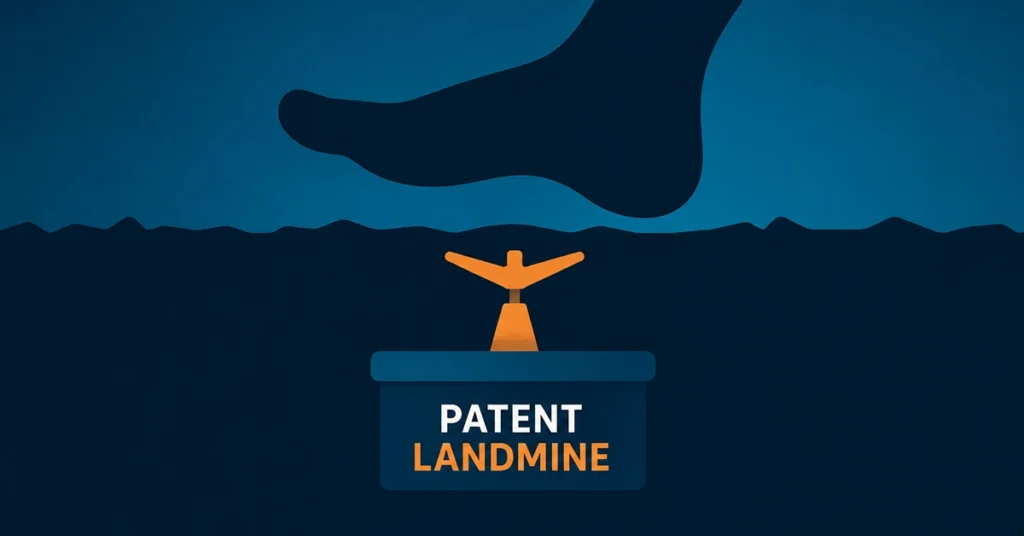
These are the “patent landmines” that can derail launches, slow growth, complicate fundraising, or impact valuation.
The good news? AI is beginning to change how companies uncover those risks earlier.
What Are Patent Landmines?
Patent landmines are hidden intellectual property risks that may exist beneath an otherwise promising product, technology, or business idea.
A company may believe they’ve created something original, only to discover that elements of their product overlap with active patent claims owned by someone else.
Sometimes the overlap is obvious.
Often, it isn’t.
Patents are notoriously difficult to interpret. Two companies may describe highly similar technology using completely different language, terminology, or technical phrasing.
That means risk isn’t always easy to spot—especially when companies are moving fast.
A founder focused on building product-market fit may never think to ask:
“Are we unknowingly stepping into someone else’s IP territory?”
Why Companies Miss Patent Risk
Most companies don’t ignore patent risk intentionally.
They simply underestimate how difficult it is to identify.
In many cases, founders assume one of two things:
“If we got a patent, we must be safe.”
“If we don’t see obvious competitors, we’re probably fine.”
Unfortunately, neither assumption guarantees freedom to operate.
Patent language is highly technical, intentionally broad, and often written to maximize legal protection.
Traditional patent searching has historically depended on keyword matching and manual review. But here’s the problem:
Important patents don’t always use the same words you do.
A competitor may describe similar technology using entirely different terminology, making relevant overlap difficult to uncover through standard searches alone.
That creates blind spots.
And blind spots create risk.
What Freedom to Operate (FTO) Actually Means
This is where Freedom to Operate (FTO) becomes important.
FTO asks a simple but critical question:
Can we safely commercialize this product without infringing someone else’s patent rights?
Unlike patentability—which asks whether an invention is unique enough to patent—FTO focuses on risk.
Can you launch it?
Can you manufacture it?
Can you license it, sell it, or scale it?
Or are hidden patents waiting to become expensive problems later?
The earlier these questions are asked, the better.
Why Traditional FTO Can Be Slow and Expensive
Historically, FTO analysis has been time-consuming, expensive, and heavily dependent on legal teams performing extensive manual review.
Patent professionals often search thousands of documents, compare claims, analyze technical language, and investigate overlapping technologies.
For startups and fast-moving companies, this can feel overwhelming.
It’s not uncommon for teams to delay FTO conversations until after product development, fundraising, or commercialization is already underway.
By then, changes become far more expensive.
The challenge isn’t simply cost.
It’s speed.
Modern innovation cycles move faster than traditional patent workflows.
How AI Is Changing Patent Risk Detection
This is where AI becomes powerful.
Instead of relying exclusively on keywords, modern AI systems can evaluate patents through semantic similarity, functional relationships, and technological overlap.
In simple terms:
AI can help identify patents that mean something similar—even when they don’t use the exact same words.
That matters because patents are often written strategically to broaden protection.
Semantic AI can surface hidden relationships between technologies, helping teams identify potential risks earlier in the product lifecycle.
Rather than waiting until late-stage diligence, founders and investors can gain earlier visibility into potential overlap.
That doesn’t replace legal counsel.
But it can help teams become smarter, faster, and more informed before expensive decisions are made.
When Should Companies Use AI for FTO?
The best time to think about patent risk is earlier than most companies expect.
AI-driven FTO exploration can be valuable:
- Before launching a product
- Before raising investment capital
- During mergers and acquisitions
- Before licensing or partnership discussions
- During R&D and product development
In other words:
Before risk becomes expensive.
The goal isn’t to slow innovation.
It’s to help companies innovate more intelligently.
Final Thoughts: Find Patent Landmines Before You Step on Them
The most dangerous patent risks are often the ones companies never saw coming.
In fast-moving industries, waiting until a product launches—or until legal issues surface—is rarely the ideal strategy.
The future of patent intelligence is shifting toward earlier visibility, faster discovery, and smarter decision-making.
Because avoiding patent landmines isn’t about fear.
It’s about clarity.
At Ontologics, we believe companies should understand where hidden patent risk lives before it becomes a costly surprise.
The best time to identify a landmine is before you step on it.
Get a Free IP Analytics Report and See Your Patent Strength in Just 24 Hours!
Get a fast, evidence-based snapshot of your patent strength before you make your next investment or strategic move. Our proprietary AI analyzes your IP in minutes and delivers insights you won’t find anywhere else.