
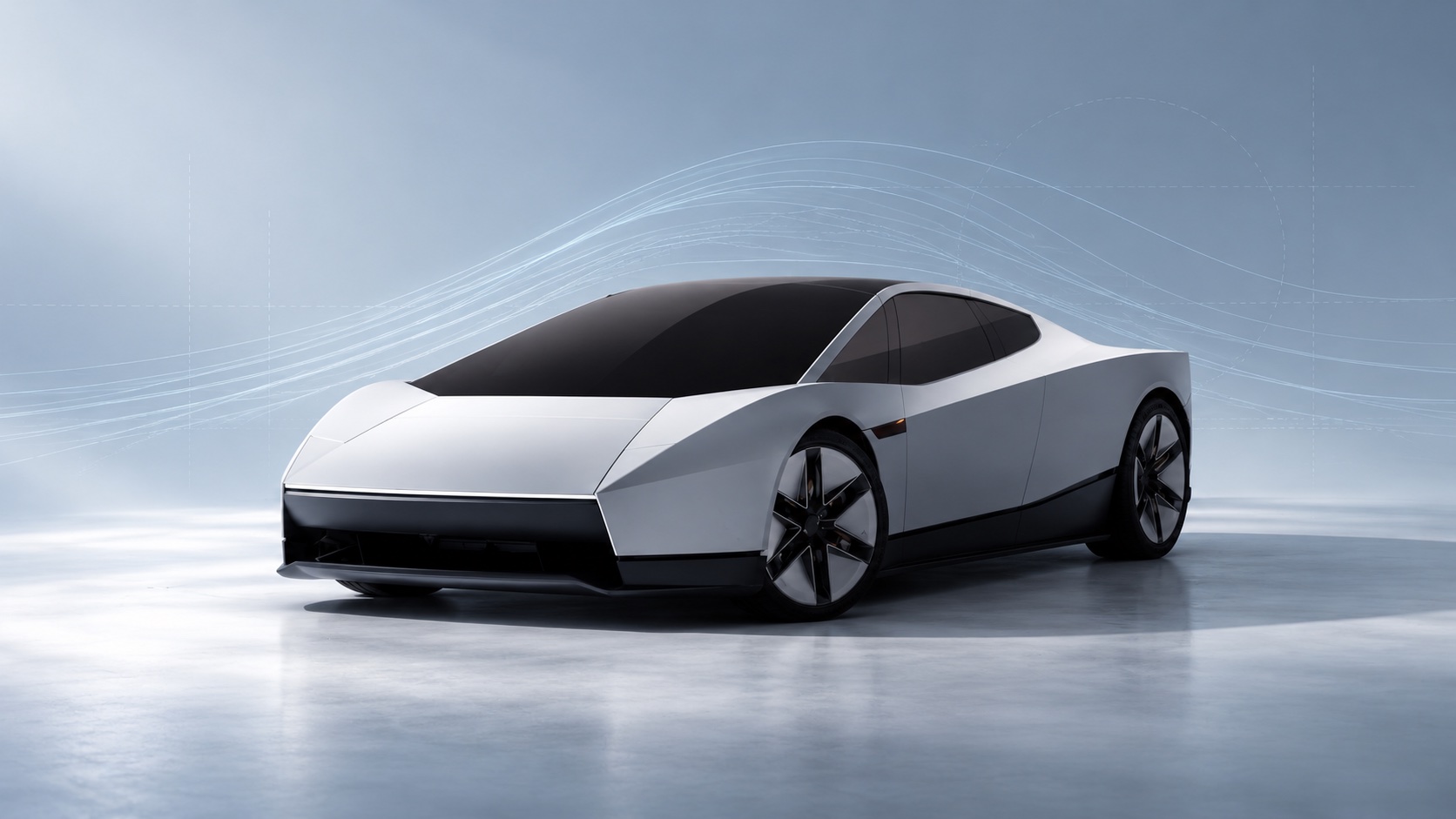
A sports car lifting itself into the air is an effective way to get attention. For business leaders, Tesla Roadster patent data offers another reason to pay attention: a chance to investigate the technical direction behind the spectacle.
At its October 15, 2026 unveiling, Tesla demonstrated a redesigned Roadster equipped with cold-gas thrusters and a suction system. The event raised a practical question: how much of the underlying engineering direction could have been understood beforehand? Associated Press coverage describes the demonstration.
Part of the answer was already in the public patent record. Before the unveiling, Tesla had secured patents describing different approaches to controlling airflow beneath a vehicle. Those documents offered a basis for investigating its work on powered aerodynamics—and for finding other companies pursuing related technologies.
The competitive edge comes from recognizing those signals early enough to inform a decision.
What the Tesla Patent Trail Revealed
Consider two pieces of Tesla’s patent trail.
On August 5, 2025, Tesla received U.S. Patent 12,377,920, “Adaptive vehicle aerodynamics for downforce.” It describes a system combining fans with deployable skirts beneath a vehicle. By adjusting the fans and skirts, the system creates and manages low-pressure regions to increase downforce under different driving conditions.
Then, on September 29, 2026—16 days before the Roadster unveiling—Tesla received U.S. Patent 12,746,987, “Electric fan car.” Its first claim describes an underbody inlet, a rear outlet, and electric ducted fans that draw air beneath the vehicle and discharge it through the rear.
Together, these disclosures provided evidence of Tesla’s interest in powered aerodynamic systems. A team monitoring that field could have used them to investigate how those approaches might affect vehicle performance, engineering priorities, or competitive positioning.
Reading Patent Signals Carefully
These records support a focused investigation. Establishing whether the demonstrated Roadster uses a particular patented configuration would require additional evidence.
The timing also deserves careful reading. The “Electric fan car” patent traces back to a January 2023 provisional application, but that date does not establish when competitors could read the information. Its B1 designation indicates a grant without a U.S. pre-grant publication. The verified public signal here is the September 2026 grant. The USPTO’s kind-code guide explains that distinction.
For a competitive intelligence team, a useful timeline tracks what was publicly knowable at each point, alongside what later records reveal about earlier development.
Looking Beyond Tesla
The analysis becomes more interesting when it expands beyond a single company.
The examiner-cited references in Tesla’s 2025 patent include documents associated with McMurtry Automotive, GM, and Hyundai. Those references provide concrete leads for investigating other approaches to vehicle downforce and airflow management. They do not establish commercial relationships or infringement.
McMurtry offers a particularly relevant example. In April 2025, the company demonstrated its Spéirling driving upside down on a purpose-built rotating platform, using its fan-based Downforce-on-Demand system. McMurtry’s public demonstration provides another piece of evidence to consider alongside the patent record.
Now the investigation has moved from one product announcement to a broader competitive question: which organizations are developing relevant capabilities, and how do their approaches differ?
Our article on Apple’s foldable iPhone and its patent clues explores a similar connection between public disclosures and product innovation.
What Tesla Roadster Patent Data Can Tell Business Leaders
The Roadster example shows how patent intelligence can support decisions about products, partnerships, and investment.
- For R&D teams, it can sharpen development priorities. A relevant disclosure can prompt engineers to examine an alternative approach, assess its tradeoffs, or revisit an assumption in their roadmap. The immediate outcome might be a focused technical review before a larger development commitment.
- For business development teams, it can broaden the search for partners. Following related inventions and their owners can surface specialists outside the usual supplier or competitor list. Those companies become candidates for further technical and commercial evaluation.
- For strategy teams and investors, it can improve competitive comparisons. The next step is to examine related patent families, claim scope, ownership, legal status, and activity over time. That creates a more informed basis for assessing where a company may have meaningful capabilities.
Each use starts with a business question. Which technical problem matters to our customers? Could a competitor’s activity affect our roadmap? Would a new capability be valuable to develop or acquire?
Those questions give the research direction. They help prevent a patent search from becoming a collection of interesting documents with no clear consequence.
Turn Patent Intelligence Into Better Decisions
A practical review combines patent evidence with product announcements, engineering assessments, and market information. It records the difference between a documented fact, an analytical inference, and an unanswered question.
In this case, Tesla Roadster patent data supports an investigation into powered aerodynamics. The final implementation and commercial outcomes remain subjects for further verification.
Ontologics helps organizations connect patent information to business decisions. Its Competitor Benchmarking capabilities examine technical focus, patent quality, and innovation momentum. This helps teams understand how their portfolios and priorities compare with those of other companies.
By the time a striking product reaches the stage, public records may already offer useful clues about the engineering behind it—and leads worth following across the wider market.
For your organization, the next step is to identify the technologies most likely to affect your business and examine what the patent record says about the companies developing them.
Request a Free Executive IP Analytics Report from Ontologics to explore your company’s patent position and competitive landscape.