
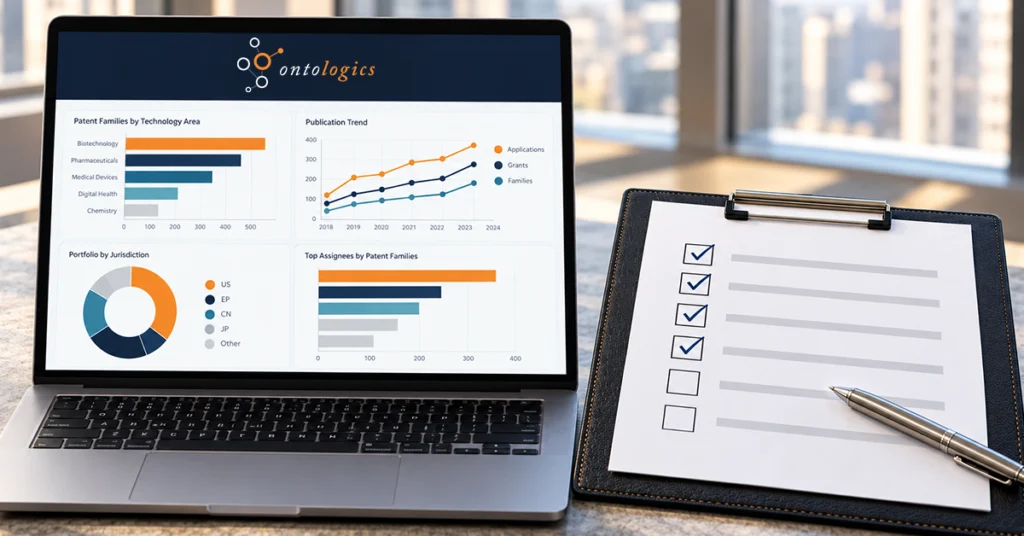
A company’s patent portfolio can look impressive in an investor presentation. But do those patents support the business you’re buying?
This patent due diligence checklist helps investors and acquisition teams identify what to review, what evidence to request, and which findings deserve closer investigation.
What Is Patent Due Diligence?
Patent due diligence examines a company’s patent assets and related risks before an acquisition, investment, or licensing transaction. It connects ownership, legal protection, and commercial relevance to the assumptions behind the deal.
Start by defining what the portfolio should contribute: protection for a core product, licensing opportunities, or support for expansion into new markets.
Then focus your review on these six areas.
1. Verify Ownership
Does the target company own the patents and applications included in the transaction?
Request: An asset inventory, executed assignments, and relevant inventor and acquisition agreements.
Investigate: Missing transfers, patents held by founders or affiliates, and inconsistencies between agreements and recorded ownership.
The USPTO’s patent assignment resources provide a starting point for researching recorded U.S. ownership changes. Counsel should review the supporting documents.
2. Check Status, Remaining Term, and Geography
Which patents are in force, how much useful life remains, and where does protection apply?
Request: Current patent-office records, fee-payment history, upcoming deadlines, and a country-by-country inventory.
Investigate: Expiring core patents, missed maintenance payments, or gaps in markets central to the acquisition plan.
Separate pending applications from granted patents. Group related filings into patent families to understand how individual rights fit together.
3. Connect Patents to Products and Revenue
How does the portfolio relate to the technology that makes the business valuable?
Request: Product specifications, product-to-patent mappings, supporting claim analysis, and relevant revenue information.
Investigate: Patents tied to discontinued products or claims of “fully patented” technology without supporting analysis.
Patent titles and abstracts are only starting points. As WIPO explains, claims define the scope of patent protection. Counsel and technical teams should assess how those claims relate to important products and features.
4. Evaluate Strength and Competitive Relevance
How well does the portfolio support the competitive advantage assumed in the deal?
Request: Relevant examination records, prior-art analyses, known challenges, and competitor comparisons.
Investigate: Unsupported claims of exclusivity, unresolved challenges to essential patents, or patent scores with unclear methodology.
Patent counts and citation metrics can help prioritize investigation. They cannot independently establish validity, enforceability, or commercial value.
5. Review Licenses and Third-Party Risks
What agreements or other parties’ rights could affect the buyer’s plans?
Request: Relevant licenses, joint-development agreements, dispute summaries, and the scope and dates of existing freedom-to-operate reviews. Coordinate access to privileged material through counsel.
Investigate: Essential licenses with uncertain transfer rights, exclusivity granted to others, or reviews that no longer reflect current products and markets.
Owning patents does not automatically establish freedom to operate. WIPO’s guidance explains why a company may still need permission to use technology patented by others.
6. Assess Costs and Strategic Fit
What will the portfolio cost to maintain, and how does that spending support the acquisition?
Request: Historical spending, upcoming fees, prosecution budgets, licensing income, and the rationale for retaining major patent families.
Investigate: Significant spending without a clear business purpose or insufficient investment in priority technologies.
Ontologics’ Patent Fee Optimization analysis can help identify assets for closer evaluation. Retention decisions should account for legal obligations and strategic value.
Why Patent Count Can Be Misleading
Consider a hypothetical target advertising 120 patent assets. The buyer wants its newest industrial sensor, but diligence reveals that much of the portfolio relates to older products. Coverage relevant to the sensor also extends to fewer markets than expected.
That finding does not automatically undermine the acquisition. It gives the buyer specific questions to resolve before assigning value to the portfolio.
Turn Your Checklist Into Action
For each material finding, record the evidence, potential business impact, responsible reviewer, and next step. Distinguish confirmed problems from unanswered questions.
AI-assisted patent intelligence can help organize portfolios and prioritize investigation. Patent counsel, technical experts, and business leaders then evaluate what the findings mean for the transaction.
For a broader perspective, read IP Due Diligence for M&A: What Most Investors Miss.
Understand the Portfolio Before You Buy
Ontologics helps investors and business leaders explore patent strength, competitive positioning, and strategic opportunities.
Request a free Executive IP Analytics Report to give your team a more informed starting point for deeper diligence.
Get a Free IP Analytics Report and See Your Patent Strength in Just 24 Hours!
Get a fast, evidence-based snapshot of your patent strength before you make your next investment or strategic move. Our proprietary AI analyzes your IP in minutes and delivers insights you won’t find anywhere else.