
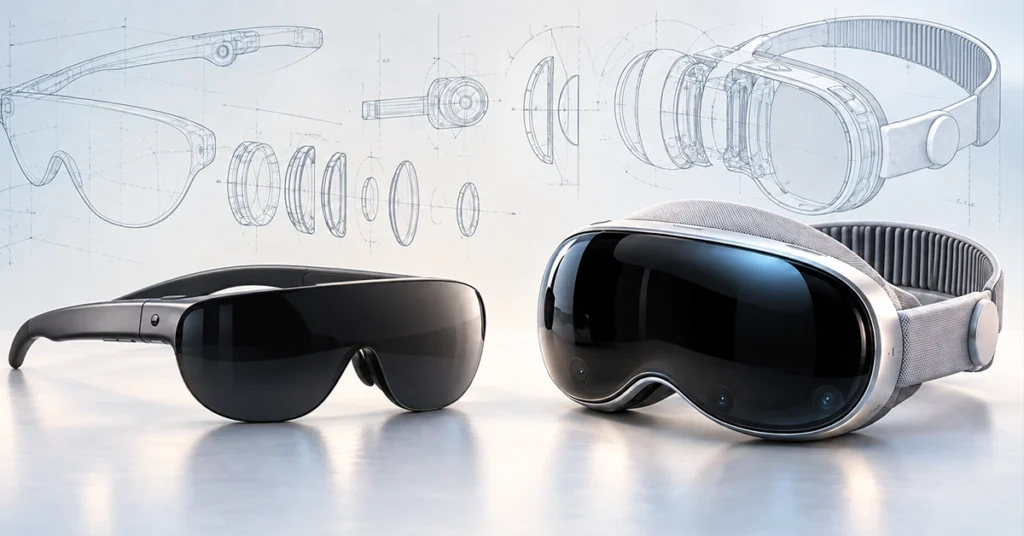
Meta’s latest announcement gives the spatial computing race a new competitive shape: glasses designed to deliver immersive entertainment and virtual workspaces with substantially less hardware on the wearer’s face.
For consumers, the comparison with Apple Vision Pro invites questions about comfort, performance, and value. For companies developing the technologies behind these experiences, it raises another question: Which patent rights could affect the products they want to bring to market?
Meta VR Glasses Enter Vision Pro’s Territory
Announced on September 23, Meta VR Glasses are scheduled to arrive in spring 2027 for $1,299.99. Meta says the glasses weigh about 100 grams, with computing, battery, and storage housed in a separate tethered puck. Their advertised capabilities include eye-and-hand controls, full-color passthrough, and multiple virtual screens. Meta’s announcement
Those capabilities put Meta’s new device in competition with experiences Apple has built around Vision Pro: navigating with eyes, hands, and voice, working across virtual displays, and watching immersive content. Apple’s Vision Pro overview
The devices take different approaches to delivering those experiences. For patent researchers, those technical differences are where the investigation begins.
The Patent Questions Beneath the Product Demonstrations
Apple offered a sense of the scale of its investment when it introduced Vision Pro in 2023. The company said it had filed more than 5,000 patents during development. That figure describes filings; it does not establish how many patents were granted or what their enforceable claims cover. Apple’s WWDC keynote
A spatial computing device brings many engineering problems together. It must display convincing images close to the eyes, interpret movement, understand its surroundings, and respond quickly enough to make interaction feel natural.
Every design choice contributes to the experience—and gives patent researchers something more specific to investigate than the broad label “smart glasses.”
Consider three areas a product team could examine:
- Eye tracking and gesture recognition. How does the system determine what a user is looking at, interpret a movement, and turn that input into an action?
- Display optics and image processing. How does the device present an image, correct distortions, and maintain clarity within its physical constraints?
- Spatial interfaces and environmental sensing. How are digital objects positioned, physical surroundings represented, and interactions coordinated
These are starting points for research, not findings that either company infringes the other’s patents.
Why Different Designs Still Require FTO Analysis
Similar user experiences can come from different technical implementations. Conversely, products that look different may still require review against some of the same patent claims.
Freedom to Operate, or FTO, examines whether a planned product or activity could infringe enforceable third-party patent rights. The analysis depends on the actual implementation, the scope of relevant claims, their legal status, and the countries involved. A product comparison or patent count cannot answer those questions on its own. WIPO’s FTO framework
For a company entering spatial computing, that means translating a product concept into specific technical questions. “We are building lighter glasses” describes a commercial objective. A useful patent investigation needs to examine how the company intends to achieve it.

What the Meta–Apple Competition Means for Smaller Innovators
An optics supplier, an interaction-software developer, and a wearable-device manufacturer may all see opportunity in the same announcement. Their research priorities will differ because their contributions differ.
Each needs to describe what it intends to build precisely enough to investigate the relevant technology. The search should also extend beyond the two brands attracting the headlines. Restricting research to Apple and Meta would leave other potential rights holders outside the review.
Timing matters, too. Investigating a technical approach while alternatives remain available gives engineering and business teams more room to respond. Findings may inform further legal analysis, design changes, or licensing discussions.
As the product and patent landscape evolve, the review should evolve with them. WIPO recommends revisiting FTO information throughout product development. WIPO’s product-development guidance
A product roadmap should also guide when a company revisits its patent research.
How AI-Assisted Patent Intelligence Supports Earlier Decisions
Patent documents do not necessarily describe technology using the language found in product announcements. Searching only for familiar feature names can miss relevant material.
Semantic analysis can help surface related concepts, organize technical relationships, and prioritize documents for closer examination. This gives teams a more useful starting point for investigating potential technology overlap.
At Ontologics, we are developing AI-powered patent intelligence tools to help businesses, investors, and innovation teams better understand complex patent landscapes. Our approach supports earlier discovery and more informed investigation, with qualified legal analysis remaining essential to an FTO determination. How Ontologics approaches AI-assisted FTO
The Meta–Apple competition makes these questions tangible. A promising product concept needs more than a compelling demonstration. Teams also need visibility into the patent rights that could influence how they develop and commercialize it.
Before committing to your next product milestone, understand the patent landscape around the technology you plan to build.
Request a free Ontologics IP Analytics Report to start exploring relevant technologies and competitive patent activity.