
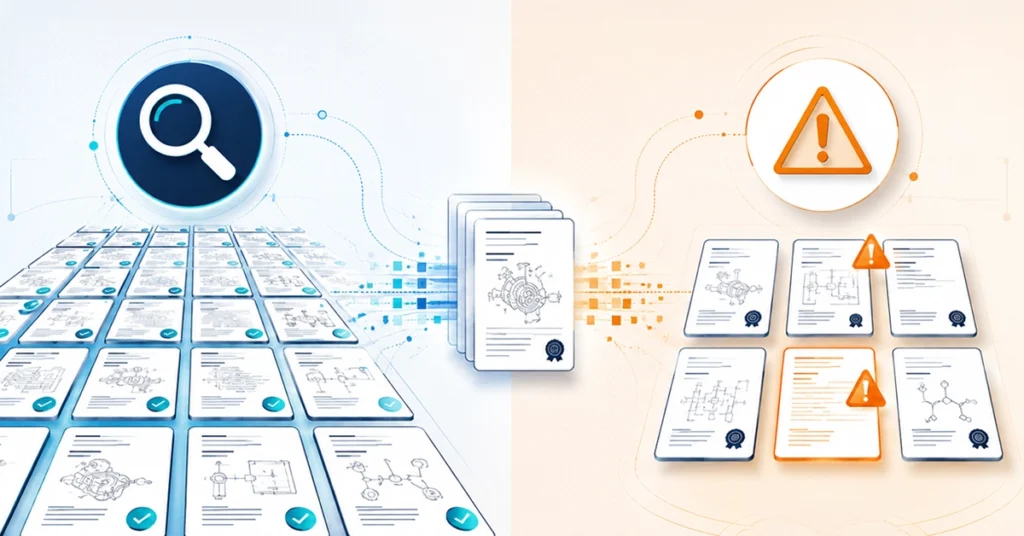
AI is making patent searching faster, smarter, and more accessible.
But there’s an important distinction companies need to understand:
An AI patent search and a freedom-to-operate (FTO) analysis are not the same thing.
AI can be remarkably effective at finding patents that are technically similar to a product, invention, or set of claims. But finding similar patents is only the beginning.
FTO asks a much more important commercial question:
Could existing patent rights create a problem for the product you’re planning to bring to market?
Even the USPTO Is Using AI to Search Patents
The shift toward AI-powered patent search is already happening at the highest levels of the patent system.
In 2025, the U.S. Patent and Trademark Office launched its Artificial Intelligence Search Automated Pilot Program (ASAP!) to test AI-powered prior-art searches before substantive patent examination. The USPTO later expanded the pilot to at least 3,200 patent applications and extended it through June 1, 2026. The program is now closed while the agency evaluates the results and considers next steps.
What makes the technology particularly interesting is how it searches.
Rather than relying solely on keywords, the USPTO says its internal AI tool derives contextual information from an application’s classification, specification, claims, and abstract. It then searches U.S. and foreign patent documents for similar information and ranks the results by relevance. Its models are trained using patent text, classifications, citations, and human-rated similarity data.
For participating applications, the system produced an AI-assisted search notice identifying potential prior art before examination began.
It’s another clear signal that AI is changing how patent information is searched.
But it also highlights an important point:
Searching for relevant patents is not the same as determining freedom to operate.
AI Patent Search Asks: What Looks Similar?
Traditional patent searches can struggle when two inventions describe similar technology using different terminology.
Semantic AI can help overcome that problem by looking beyond exact words and identifying similarities in technical meaning.
That can make AI extremely useful for discovering patents a keyword search might miss.
But similarity alone doesn’t necessarily mean commercial risk.
A patent that appears highly relevant could be expired. Its applicable claims could have been canceled or abandoned. It might only be enforceable in a jurisdiction where you don’t plan to sell. Or the claims that remain in force may not actually cover the specific features of your product.
Finding the patent is one thing. Understanding whether it matters is another.
FTO Asks: What Could Get in the Way?
A freedom-to-operate analysis starts with identifying relevant patent rights, but it has to go much further.
FTO may involve understanding:
- Which patent claims are currently enforceable
- Whether those claims potentially read on particular product features
- Patent families and related applications
- Continuations and pending claims
- Patent status and expiration
- Relevant jurisdictions
- How the claims relate to the product that will actually be commercialized
This is why asking an AI system to “find patents similar to my product” doesn’t tell you whether you have freedom to operate.
The first question is primarily about discovery.
The second is about risk.
Better AI Search Is Still Critical to Better FTO
That doesn’t mean AI isn’t valuable for FTO.
Quite the opposite.
The USPTO’s investment in contextual AI search demonstrates where patent research is heading. Systems that understand technical meaning can uncover relevant intellectual property faster and more comprehensively than searches that depend primarily on matching terminology.
For FTO, better discovery can mean finding potential risks earlier.
But the quality of the intelligence surrounding those results matters just as much as the AI model performing the search.
That’s where purpose-built patent intelligence becomes critical.
At Ontologics, the goal isn’t simply to use AI to return a longer list of similar patents. It’s to combine advanced AI with structured patent information that can help teams identify, organize, and better understand potentially relevant intellectual property in the context of freedom to operate.
AI can help find the signal. FTO requires understanding what that signal means.
And while AI-powered technology can dramatically accelerate and strengthen the process, formal FTO opinions should ultimately involve qualified patent counsel.
AI Is Changing FTO—Not Replacing It
The question is no longer whether AI can search patents.
It can.
The USPTO itself is testing how AI can make patent searching more contextual, efficient, and useful.
The more important question for companies is what happens after potentially relevant patents are found.
An AI patent search can help show you what’s out there. An FTO analysis helps you understand what may actually be in your way.
Go Beyond AI Patent Search
Finding similar patents is only the beginning. Ontologics uses AI-powered FTO analysis to help teams move beyond search and identify the patent rights that may actually matter to their products.
If you’re developing or commercializing new technology, see how Ontologics can help you understand the patent landscape faster and make more informed decisions.
Get a Free IP Analytics Report and See Your Patent Strength in Just 24 Hours!
Get a fast, evidence-based snapshot of your patent strength before you make your next investment or strategic move. Our proprietary AI analyzes your IP in minutes and delivers insights you won’t find anywhere else.