
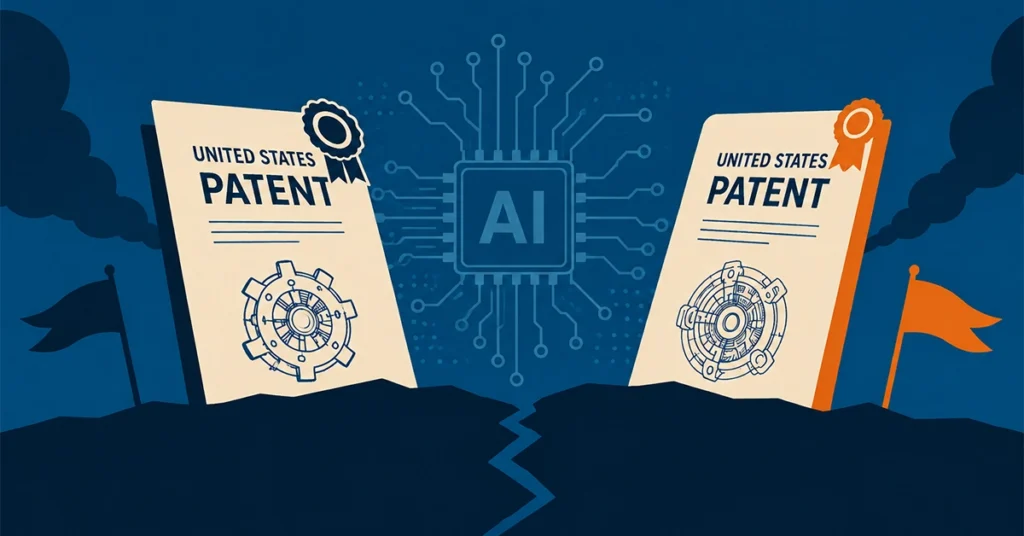
AI companies have spent the past few years racing to build faster.
Now some are being forced to ask a different question:
Were we actually free to build it?
In June, AI.Law sued legal AI company Eve, alleging that Eve’s document-drafting technology infringes a patent covering the use of AI to transform unstructured information into formatted legal documents.
A month later, the University of Tennessee Research Foundation sued Anthropic, alleging that its AI systems infringe two patents related to neural-network and neuroscience-inspired computing technology. Reuters described it as the first known patent infringement case against Anthropic. Anthropic has said it disagrees with the allegations and intends to defend itself.
Neither case has established infringement. But together, they point to something important:
The AI patent landscape is no longer just something to watch. It is becoming something companies have to navigate.
Moving Fast Doesn't Mean You're Free to Operate
For much of the generative AI boom, intellectual property conversations have focused on copyright—training data, books, images, music, and other content used to develop AI models.
Patent risk is different.
Under U.S. patent law, infringement can arise from making, using, offering to sell, or selling a patented invention without authorization. The statute focuses on whether the patented invention is being practiced—not simply whether one company intentionally copied another.
That distinction matters for AI companies.
Two teams can independently pursue similar approaches. Two startups can solve the same technical problem. A company can develop something completely in-house and still find itself operating within the scope of someone else’s patent claims.
Innovation alone does not equal freedom to operate.

AI Has Compressed the Development Cycle
This is where the problem gets bigger.
AI is dramatically reducing the time between idea, prototype, product, and deployment. Teams can test concepts faster, write code faster, analyze markets faster, and launch products faster than ever before.
But patent risk hasn’t disappeared simply because the development cycle has accelerated.
In many companies, freedom-to-operate analysis still happens relatively late:
Build → Validate → Raise → Prepare to Launch → Check FTO
By that point, the company may have already invested heavily in a technical direction.
A better model is increasingly:
Explore → Understand the Landscape → Build → Monitor → Scale
The U.S. Patent and Trademark Office itself identifies infringement or “freedom to operate” searching as a reason to conduct patent searches before substantial resources are committed.
FTO Needs to Become Part of the Innovation Process
Freedom to operate shouldn’t be viewed only as a legal checkpoint before launch.
It can be intelligence that helps shape the product earlier.
Understanding the patent landscape can help teams identify areas of potential overlap, recognize active competitors, uncover alternative technical approaches, and make better decisions about where to invest development resources.
And as AI makes product development faster, the tools used to understand that landscape need to become faster too.
Traditional patent analysis can be difficult to integrate into rapid development cycles. Millions of documents, complex claim language, inconsistent terminology, and technologies described in completely different ways can make relevant patents difficult to identify.
This is precisely where AI can change patent intelligence.
Rather than relying only on exact keywords, AI-assisted analysis can help teams identify conceptual and semantic relationships across large patent datasets—giving innovators a clearer view of the landscape surrounding what they are building.
The Earlier You Know, the More Options You Have
The point of FTO isn’t to slow innovation down.
It’s to give innovators more options before their options become expensive.
A potential patent conflict discovered early may influence architecture, product design, licensing strategy, acquisition decisions, or the direction of R&D.
The same issue discovered after a product has launched can become considerably harder to address.
The recent lawsuits involving Eve and Anthropic are reminders that the companies defining the AI era are not building on an empty landscape.
There are patents around them.
And as AI innovation accelerates, those landscapes will only become more crowded.
AI has shortened the distance between idea and product. FTO needs to shorten the distance between invention and patent intelligence.
At Ontologics, we believe patent intelligence should move at the speed of innovation. If your team is building in a rapidly evolving technology space, contact us to learn how a more intelligent approach to freedom-to-operate analysis can help you see the landscape earlier.
Get a Free IP Analytics Report and See Your Patent Strength in Just 24 Hours!
Get a fast, evidence-based snapshot of your patent strength before you make your next investment or strategic move. Our proprietary AI analyzes your IP in minutes and delivers insights you won’t find anywhere else.